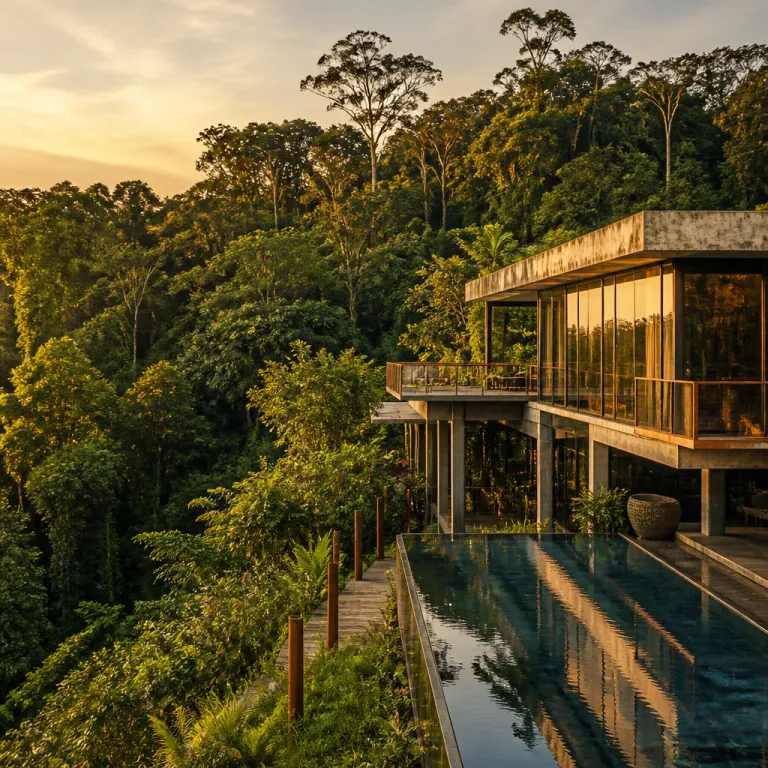
Where conservation lines are drawn: why luxury sits at the forest edge
Brunei holds one of the world’s highest ratios of protected forest to national territory, and that single fact quietly dictates where every serious luxury hotel can be built. Government submissions to the UN Framework Convention on Climate Change and figures cited by the Forestry Department of Brunei Darussalam indicate that around 70 percent of the country remains under forest cover, with more than half of that area classified as protection or conservation forest under national land use plans. When the Brunei Government enforces strict zoning rules, mandatory environmental impact assessments and sustainable forest management under its National Forestry Policy and its participation in the Heart of Borneo initiative, the result is a hospitality map where each resort or lodge must sit at the edge of the rainforest rather than carve deeper into it. For couples planning a romantic escape, this conservation led luxury hotel pattern means you sleep in comfort while the jungle remains largely intact beyond the last path of the property.
Forest cover above seventy percent is not a tourism slogan; it is a structural constraint that shapes every new hotel, spa wing and rainforest lodge concept in Brunei Darussalam. Conservation policies such as the 1989 National Forestry Policy, subsequent sustainable forest management guidelines and the 2007 Heart of Borneo declaration influence hotel locations, with objectives that explicitly aim to preserve forests and promote eco tourism, so developers work with narrow footprints, elevated walkways and careful positioning under the canopy. The conservation policy impact is clear in Bandar Seri Begawan and beyond, where luxury properties frame the forest as a backdrop rather than a resource to be consumed, turning each suite window into a curated view of protected land instead of a cleared hillside.
For travelers, this boundary model changes what a forest focused luxury stay in Brunei feels like in practice. You may arrive at a high end hotel near a park or forest trail, but the most immersive rainforest experiences happen just beyond the gate with licensed guides and regulated operators accredited by the Ministry of Primary Resources and Tourism. It attracts eco tourists seeking natural experiences, and it reassures guests that their presence supports long term protection rather than short term extraction, a balance that underpins the emerging identity of Brunei tourism and is echoed in official tourism board messaging and national development plans.
Bandar Seri Begawan to Temburong: jungle at the lobby’s edge
In Bandar Seri Begawan, the capital often shortened to Bandar Seri, the luxury story starts on the river and ends at the forest line. Couples check into a riverside hotel or urban resort in Brunei Darussalam, then step onto a water taxi that threads past Kampong Ayer before heading toward the darker green of the Temburong rainforest. This is where the conservation driven luxury hotel dynamic becomes tangible, as the city’s polished service standards give way to the raw soundscape of cicadas and hornbills within a short journey, a contrast frequently highlighted in Brunei Tourism Board promotional materials and visitor itineraries.
At Temburong adjacent properties and simple rainforest lodge operations, you feel the jungle meet the lobby in small but powerful ways. Breakfast on a terrace might come with breathtaking views of mist lifting off the forest canopy, while a short guided walk reveals a forest trail where gibbons sometimes call within earshot of guests still in their suite. Official descriptions of Ulu Temburong National Park emphasize this immediacy, noting that visitors can reach primary rainforest via boat and canopy walkways without new roads or large scale clearing. A frequently cited explanation in tourism datasets captures the draw with unusual clarity: “How does Brunei's forest cover affect tourism? It attracts eco-tourists seeking natural experiences.”
For couples who want to go deeper, staying near community based projects such as those described in regenerative travel reports on Sumbiling Eco Village offers a different lens on luxury. Here, the value lies less in marble finishes and more in respectful engagement with local communities that manage nets in the river, forest gardens and long term conservation activities supported by local NGOs and village cooperatives. A typical day might include a guided river trip, a visit to a longhouse and a shared meal prepared with ingredients from community plots, illustrating how tourism revenue can reinforce conservation incentives. You still return to a comfortable lodge or hotel room at night, but the rainforest centered luxury experience is defined by the day’s encounters with the canopy, river and wildlife, not by the thread count alone.
Berakas and beyond: when an urban forest becomes a luxury amenity
Along the coast near Bandar Seri Begawan, Berakas Forest Recreational Park shows how conservation and comfort can share the same shoreline. This urban forest, protected under a long running cooperation framework between the Forestry Department and the Ministry of Development, is being carefully positioned as an ecotourism asset rather than a blank slate for another generic resort in Brunei. For couples choosing a conservation minded luxury stay in this area, the park functions as an extended garden, with shaded forest trails and picnic clearings replacing manicured lawns and ornamental fountains.
Hotels and lodges near Berakas increasingly treat the forest as their primary amenity, not an afterthought. A spa may offer treatments that begin with a guided walk under the canopy, while suites are angled to frame the park’s treeline and its occasional wildlife sightings instead of only the sea. This approach aligns with the rise in eco tourism and the growth in sustainable hotels noted by regional observers, and it is reflected in curated lists of Brunei’s most exclusive eco friendly hotels for sustainable luxury stays on specialist platforms such as mybruneistay.com, which highlight properties that advertise direct access to Berakas trails, low impact lighting along forest edges and participation in tree planting or beach clean up activities.
For travelers, the practical question is how to read between the lines when browsing a booking website. Look for a property that explains its relationship to the park, its use of sustainable materials and its partnerships with local communities, rather than simply advertising high thread count linens and a generic spa. When a Brunei luxury hotel listing highlights guided forest trail access, low impact lighting, waste reduction programs and long term conservation commitments aligned with national policies, and when it mentions staff training or collaboration with local associations, you can be more confident that your stay supports the balance between ecology and economy that defines modern Brunei tourism.
Carbon, canopy and the paradox of oil funded protection
Brunei’s dense rainforest and high forest cover function as a vast natural carbon sink, and that reality quietly outperforms many offset programs marketed by luxury chains elsewhere in Southeast Asia. Government reports submitted to the UN Framework Convention on Climate Change note that land use, land use change and forestry remain a significant carbon sink for the country, with removals from forests helping to balance emissions from other sectors. When you book a conservation oriented luxury stay in Brunei, you are entering a country where energy wealth has underwritten a policy choice to keep most of the land under trees rather than under concrete. The context is complex, but for guests it means that the forest backdrop to your suite or lodge is not a fragile remnant; it is part of a national strategy.
Luxury hotel developers working near the forest edge must now think beyond simple carbon offset certificates. Environmental impact assessments, eco friendly construction methods and collaboration with environmental NGOs are no longer optional extras; they are baseline expectations in Brunei Darussalam, reflected in planning guidelines and tourism development briefings. The Green Canopy Rainforest Eco Tourism Circuit, described in regional tourism cooperation documents as a cross border route linking Brunei with neighboring countries, reinforces this by rewarding properties that integrate canopy level experiences, guided forest trail excursions and education about local communities into their service standards.
There is an ethical tension at the heart of this model, and couples who care about sustainability should acknowledge it. Oil revenues fund both the conservation policies that protect the rainforest and the infrastructure that allows high end tourism to operate at the forest edge, from roads to reliable net connectivity and email based concierge services. When you choose a forest facing luxury hotel in Brunei, you are participating in that paradox, but you can still tilt your impact by favoring properties that publish clear long term conservation commitments, refer to national climate and forestry strategies, and share transparent data on their environmental performance in sustainability reports or public statements.
How to choose: reading a Brunei luxury listing through a conservation lens
On a booking page, the difference between a standard luxury hotel and a genuinely conservation aligned property in Brunei can be subtle. Start with location; a resort or lodge that sits near a protected park, a named forest reserve or a recognized rainforest lodge hub is more likely to operate under stricter environmental oversight. In Bandar Seri Begawan and other parts of Brunei Darussalam, this often means being close to a forest trail network, a mangrove corridor or a river that links directly to the rainforest, as mapped in official tourism brochures and destination guides.
Next, examine how the hotel talks about its relationship with local communities and the surrounding forest. Look for references to guided canopy walks, wildlife interpretation, support for village based tourism and long term conservation partnerships rather than vague green slogans. Specialist platforms such as mybruneistay.com’s coverage of Brunei’s role at major travel trade shows can help you decode which properties are setting serious service standards in sustainable luxury and which are simply borrowing the language, especially when they quote awards, certifications or formal partnerships with conservation agencies and responsible tourism programs.
Finally, pay attention to the details that reveal how a forest focused luxury stay in Brunei will feel once you arrive. Are suites oriented toward breathtaking views of intact forest, or only toward a pool and the road? Does the spa integrate natural soundscapes and low impact design, or is it sealed off from the rainforest entirely? When a property explains how it manages waste, energy and guest activities in a way that respects conservation laws and references national guidelines, and when staff can answer questions about local wildlife and community projects, you can book with more confidence that your romantic escape supports the same forests that make Brunei’s luxury landscape so distinctive.
FAQ
How does Brunei’s high forest cover shape luxury hotel locations?
Extensive forest protection means most luxury hotels and resorts in Brunei are built at the edges of protected areas rather than inside them. Strict land use regulations and conservation policies, including the National Forestry Policy and Heart of Borneo commitments, push developers to position each property as a viewing platform for the rainforest instead of clearing new land. For guests, this creates a conservation oriented luxury experience where you stay in comfort while the core jungle remains largely untouched.
What should couples look for in a sustainable luxury hotel in Brunei?
Couples should prioritize hotels and lodges that clearly explain their environmental impact assessments, use of sustainable materials and partnerships with local communities. Listings that highlight guided forest trail access, canopy walks, wildlife interpretation and transparent long term conservation commitments usually indicate stronger alignment with national conservation goals. When a property in Brunei Darussalam treats the rainforest as a protected neighbor rather than a theme, and refers to specific programs or policies, it is more likely to deliver both romance and responsibility.
Is Brunei’s conservation model for luxury tourism replicable elsewhere?
Brunei’s model relies heavily on state policy and energy revenues, which fund both forest protection and tourism infrastructure. Other destinations can adopt strict land use rules and promote eco tourism, but few have the same fiscal cushion to leave such a high percentage of land under forest. The ethical paradox remains, yet Brunei’s conservation led luxury approach still offers lessons on boundary based development, the value of treating intact ecosystems as long term assets and the importance of embedding tourism in national climate and forestry strategies.
How close can guests get to the rainforest from major hotels?
From many hotels in Bandar Seri Begawan and nearby coastal areas, guests can reach mangrove corridors or forest edges within a short drive or boat ride. Properties near Temburong or Berakas Forest Recreational Park often offer direct access to guided walks, canopy platforms and river trips that enter the rainforest without requiring new construction inside protected zones. This proximity is a hallmark of Brunei’s forest based luxury experience, where jungle immersion is measured in minutes rather than hours of travel.
Do luxury hotels in Brunei support local communities around the forest?
Many higher end properties now work with nearby villages to provide guiding, cultural experiences and supply chains that benefit local communities. Guests may join river trips run by residents, dine on ingredients sourced from community farms or participate in educational activities that explain conservation practices. Choosing hotels that describe these partnerships in detail, and that reference collaboration with local associations or NGOs, helps ensure your spending reinforces both social and environmental goals in Brunei Darussalam.